
Spectral Modification#
Warning
Check warranty terms before performing any modifications to your Miniscope.
The UCLA Miniscope v4 as sold by Open Ephys is compatible with green indicators e.g. GCaMP6f in its Standard configuration (Standard) or red indicators e.g. jRGECO1a, PinkyCaMP in its Lime configuration (Lime). It can also be modified for other fluorophores.
Standard#
470nm (blue) LED excitation light source (LXZ1-PB01 ) to image a green indicator e.g. GCaMP6f :
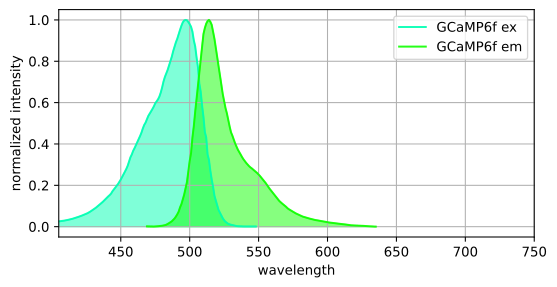
1 ET470/40x (4x4x1 mm) excitation filter
1 ET525/50m (4x4x1 mm) emission filter
1 T495lpxr (4x6x1 mm) dichroic mirror
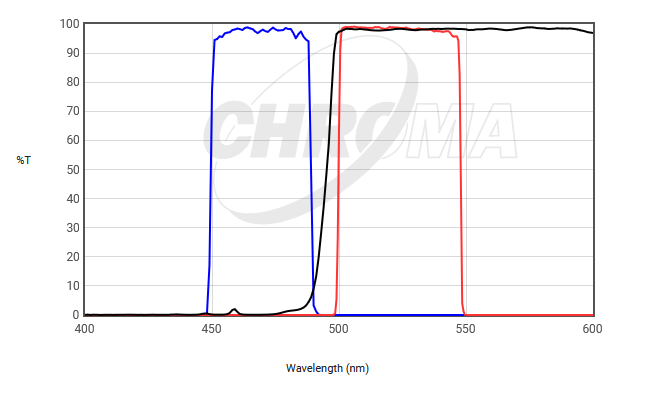
All three transmission spectra on a single plot .#
Filter |
ET470/40x |
ET525/50m |
T495lpxr |
Color |
Blue |
Red |
Black |
The standard UCLA Miniscope v4 is sold by Open Ephys both as a pre-assembled, fully-tested unit and as an assembly kit for self-construction, with all components included.
Lime#
560nm (yellow-green) LED excitation light source (LXZ1-PX01 ) to image a red indicator e.g. jRGECO1a , PinkyCaMP , etc.:
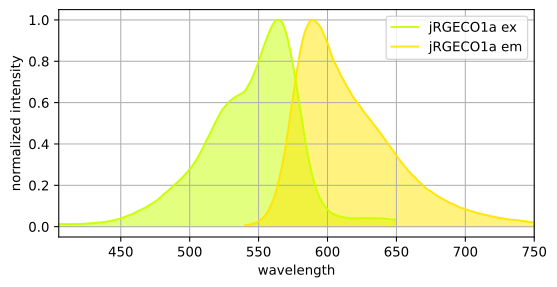
1 ET560/40x (4x4x1 mm) excitation filter
1 ET630/75m (4x4x1 mm) emission filter
1 T585lpxr (4x6x1 mm) dichroic mirror
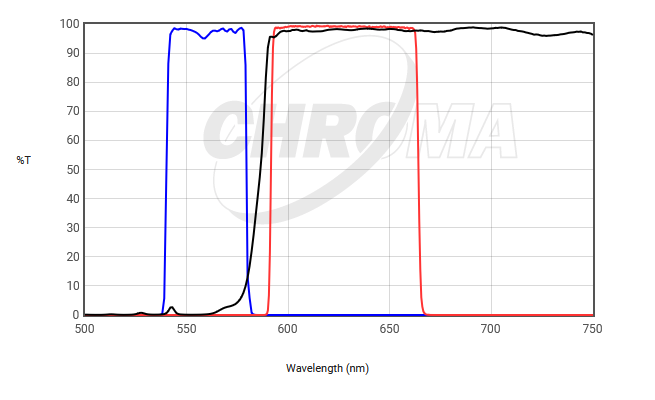
All three transmission spectra on a single plot #
Filter |
ET560/40x |
ET630/75m |
T585lpxr |
Color |
Blue |
Red |
Black |
The Lime UCLA Miniscope v4 is sold by Open Ephys as a pre-assembled, fully-tested unit.
Other#
It is also possible to adapt the UCLA Miniscope v4 to fluorophores with spectral characteristics that aren’t compatible with standard or lime configurations. Refer to Chroma (a worker coop from which Open Ephys sources its filters) to look at your options for swapping out the filters and dichroic mirror. They produce and sell a variety of off-the-shelf filters/dichroic mirrors and also assist in producing custom solutions for your experiments. The process of choosing the best set of light source, filters, and dichroic is often an iterative balancing process that attempts to maximize emission light into the sensor, minimize excitation light into the sensor, and maximize excitation light into the sample. This maximizes SNR and minimizes heat dissipation from the LED/LED driver.
How To Modify Spectral Compatibility#
To reconfigure the spectral compatibility (e.g. the LED/Dichroic/Filters combination), follow the Assembling the UCLA Miniscope V4 instructions while substituting standard excitation/emission filters and dichroic mirror with the ones you’d like to use. It is easier and recommended to perform this modification starting with an unassembled UCLA Miniscope v4 than starting with an already-assembled UCLA Miniscope v4.
Note that if you desire to use an LED that is not included in the lime or standard configurations, you must solder it yourself which requires additional materials and know-how during the assembly process.